AI spending is booming, but profits do not always follow: McKinsey report

Companies around the world are pouring money into AI, but a new McKinsey & Company survey suggests the payoff is still concentrated in a small slice of standout performers.
Globally, 89% of firms now use AI regularly in at least one business function, and 44% say it is scaling across the whole enterprise – up from 38% a year ago. Yet only 37% report that AI has actually helped their bottom line, a number that has barely moved year over year.
The gap is especially stark in the US, where the AI race has become both a business strategy and a matter of national policy. Leading AI companies like OpenAI and Anthropic have pushed enterprise adoption hard over the past year, rolling out increasingly capable coding agents and enterprise tools that companies are using to automate everything from customer service to financial analysis.
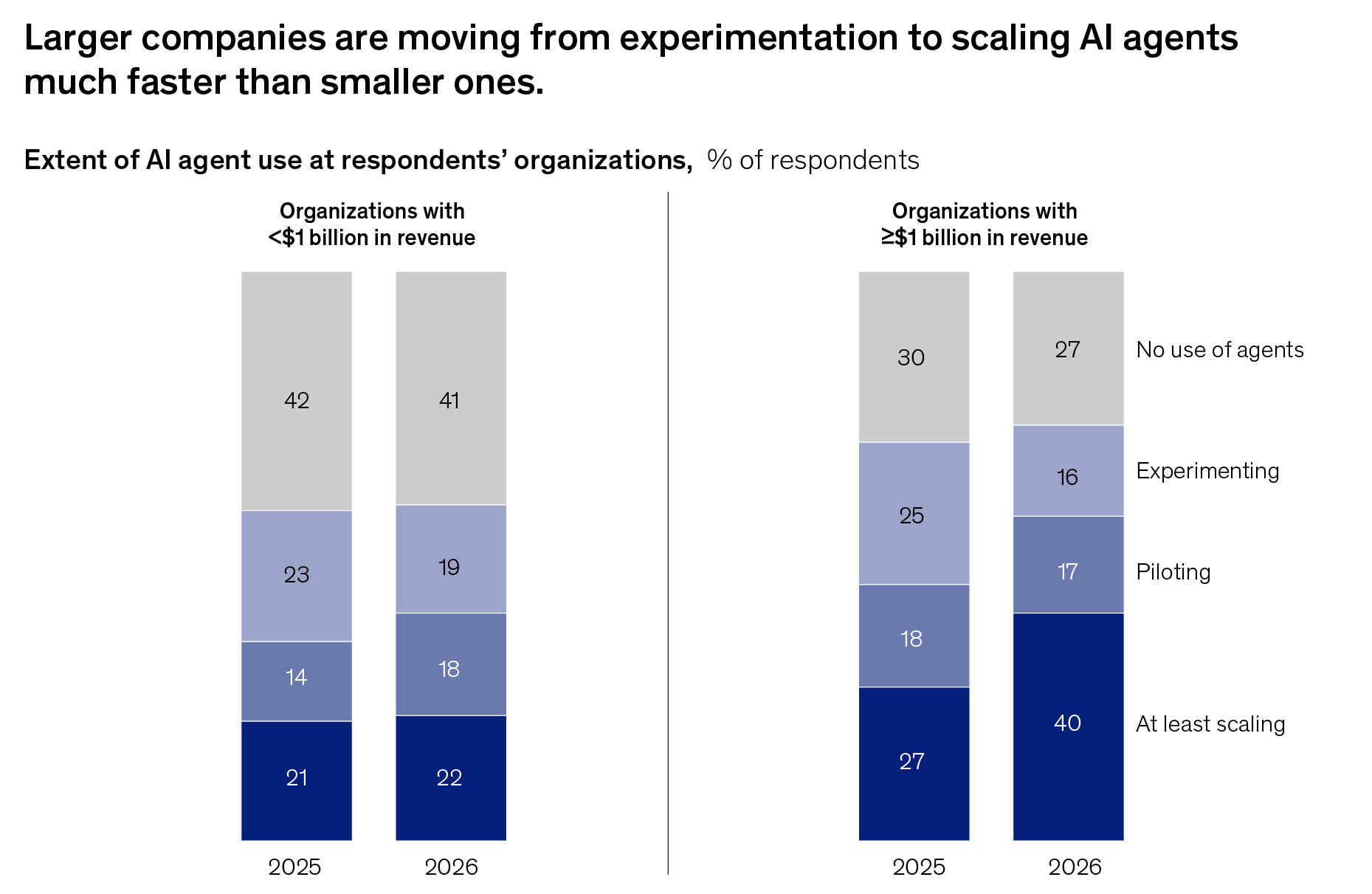
Coding agents in particular have taken off: Roughly 31% of large enterprises are now scaling them, and nearly a third of companies say they have decided to build software in-house with AI tools rather than buy it – a trend that could reshape corporate tech budgets.
High performers do things differently
McKinsey’s report points to a small group – just 6% of companies surveyed – that qualify as ‘AI high performers’ based on measurable earnings impact. What sets them apart is not spending, but approach: About three-quarters have fundamentally redesigned their workflows around AI, versus roughly a quarter of everyone else, and they are far more likely to pursue growth and innovation rather than pure cost-cutting.
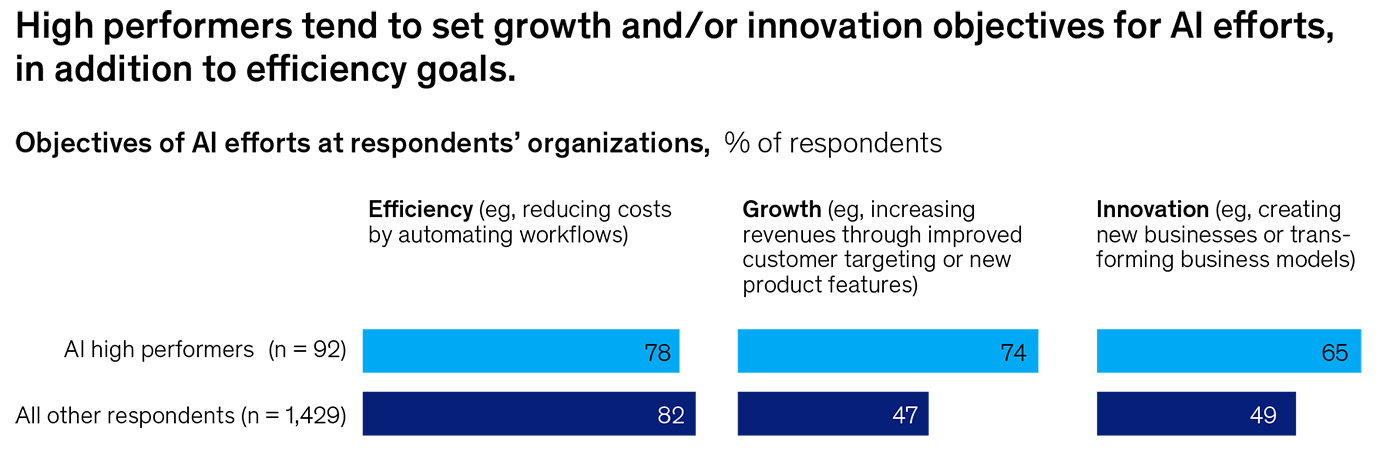
They are also about twice as likely to have strong senior-leadership ownership of AI strategy and clear metrics for measuring its impact – suggesting that discipline, not just access to the technology, separates the winners.
The Workforce Question
Anxiety about AI and jobs continues to build: 39% of respondents now expect their company’s headcount to shrink because of AI over the next year, up from 32% last year.
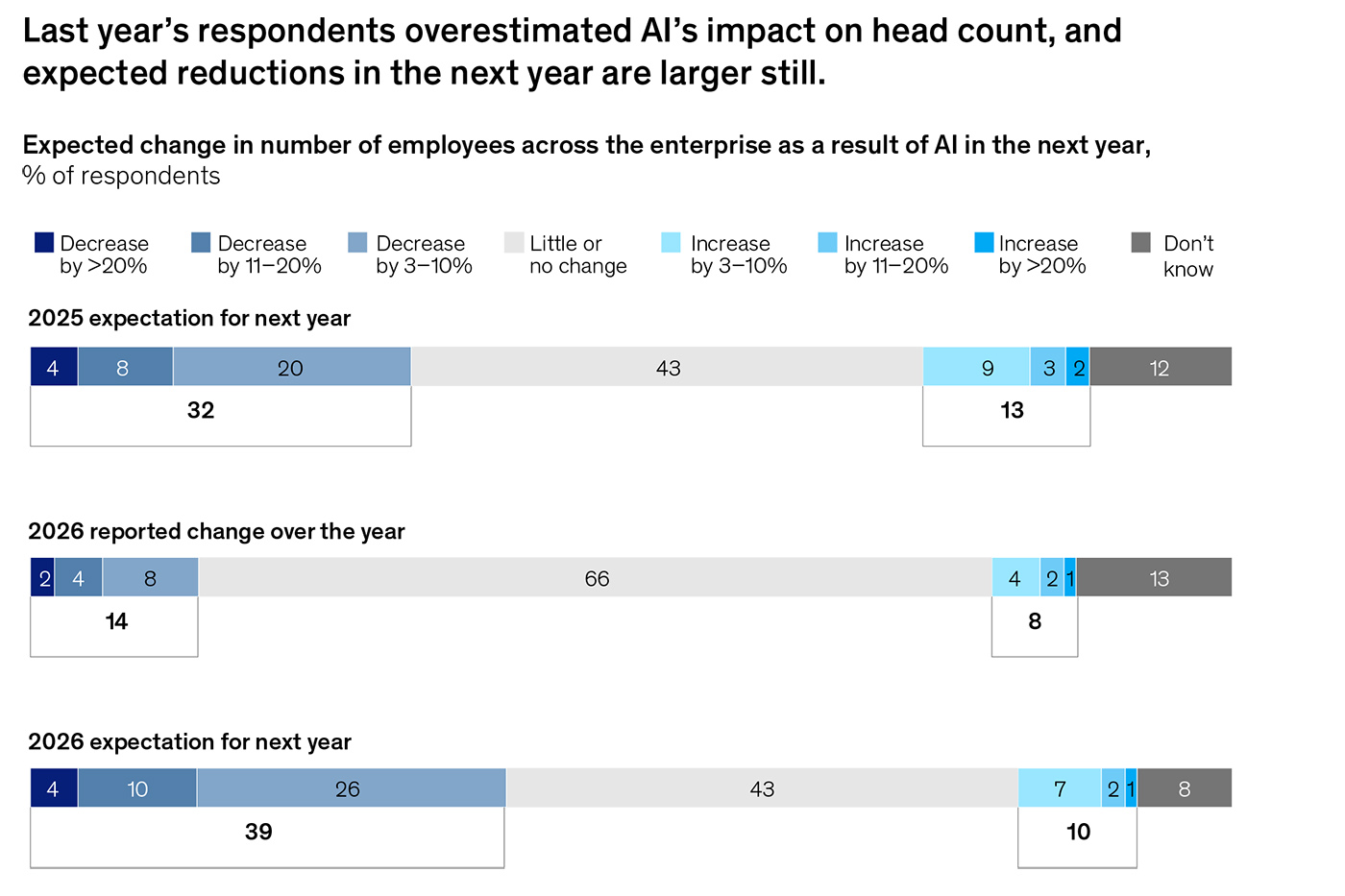
Despite that, the actual impact has so far been smaller than feared – only 14% report an AI-driven workforce decline that is already happened. Still, cases like JPMorgan’s operations cuts suggest that gap may be narrowing as agentic tools mature and companies get more comfortable letting AI take over full workflows rather than single tasks.
Washington leans in
That corporate rush has been reinforced by federal policy. The second Trump administration has moved to strip away Biden-era AI safety rules in favor of faster deployment, framing the shift explicitly as a competition with China.
In July 2025, the White House released its ‘Winning the AI Race’ plan – a roughly 90-point blueprint built around three pillars: Accelerating innovation, building infrastructure, and leading in international AI diplomacy and security. The plan discourages state-level AI regulation, pushes for faster data-center and energy permitting, and calls for the federal government to only contract with AI developers whose systems avoid what officials call top-down ideological bias.
The plan plays down efforts to limit AI’s potential harms in favor of expanding the infrastructure that powers the industry – even backing continued use of federal land and power grids to keep data centers running. Officials have framed export controls and infrastructure investment as tools to keep US-built AI ahead of Chinese rivals such as DeepSeek and Qwen.
JPMorgan bullish on AI
Few US companies have wagered on AI adoption as big as JPMorgan Chase. The bank has reclassified AI from an experimental project to core infrastructure, with roughly 200,000 employees using its internal AI assistant daily and a 2026 technology budget near $19.8 billion.
But JPMorgan’s experience also captures McKinsey’s central finding: Productivity gains do not automatically translate to profit. The bank’s leaders acknowledged that time saved in one part of a process often just shifts the bottleneck elsewhere rather than eliminating cost. JPMorgan is also cutting operations staff even as it expands AI-driven roles like ‘context engineers’, underscoring that adoption is reshaping headcount even where it has not yet transformed the balance sheet.
"A striking finding this year is the gap between individual gains and enterprise impact," said Dan Tinkoff, senior partner at McKinsey.
"Employees are building AI fluency – on their own or with assistance from company rollouts of general-purpose AI tools – and that shift matters. The opportunity for business leaders is to harness the energy created by growing employee literacy and to establish an operating model that enables them to lead the end-to-end reimagining of workflows in their areas of responsibility at speed and at scale."