As data centers boom, construction risks loom

Power and equipment constraints, labor shortages, and design changes contribute to a growing risk of delays and disputes in data center construction, according to a thought piece from the consultants at HKA.
The white paper – “Data center construction in the age of AI: Emerging risks, delays, and disputes” – was authored by Jorge Berrios, principal; Scott Hollingsworth, partner; and Daniel Kwon, partner.
The data center buildout is currently booming on the back of generative AI development, with data centers expected to attract hundreds of billions of dollars in investment in the US this decade. However, power constraints, permitting challenges, and local opposition are causing a growing share of projects to face delay or uncertainty.
Such large-scale, complex, and urgent infrastructure projects are inherently prone to disputes, the authors say, but many data center disputes remain confidential to preserve investor confidence and positive market perception.
The HKA article provides three hypothetical scenarios that could result in data center construction delays – drawing on public information and consultant experience.
Grid interconnection and equipment delays
A 300 MW data center was intended to connect directly to the regional power grid, but evolving interconnection requirements and regulatory changes significantly delayed hook-up. In response, the developer evaluated on-site generation options, initially opting for natural gas and diesel generators.
However, global supply chain disruptions, increased demand for generators, and evolving regulations for emissions made the gas and diesel generators untenable.
The developer then opted for fuel-cell solutions, which had a more favorable regulatory profile – although the shift required a substantial redesign of electrical and mechanical systems.
The project ultimately completed significantly late, with the contractor facing LD penalties of $5K per day after a 45-day grace period. The dispute eventually proceeded to arbitration.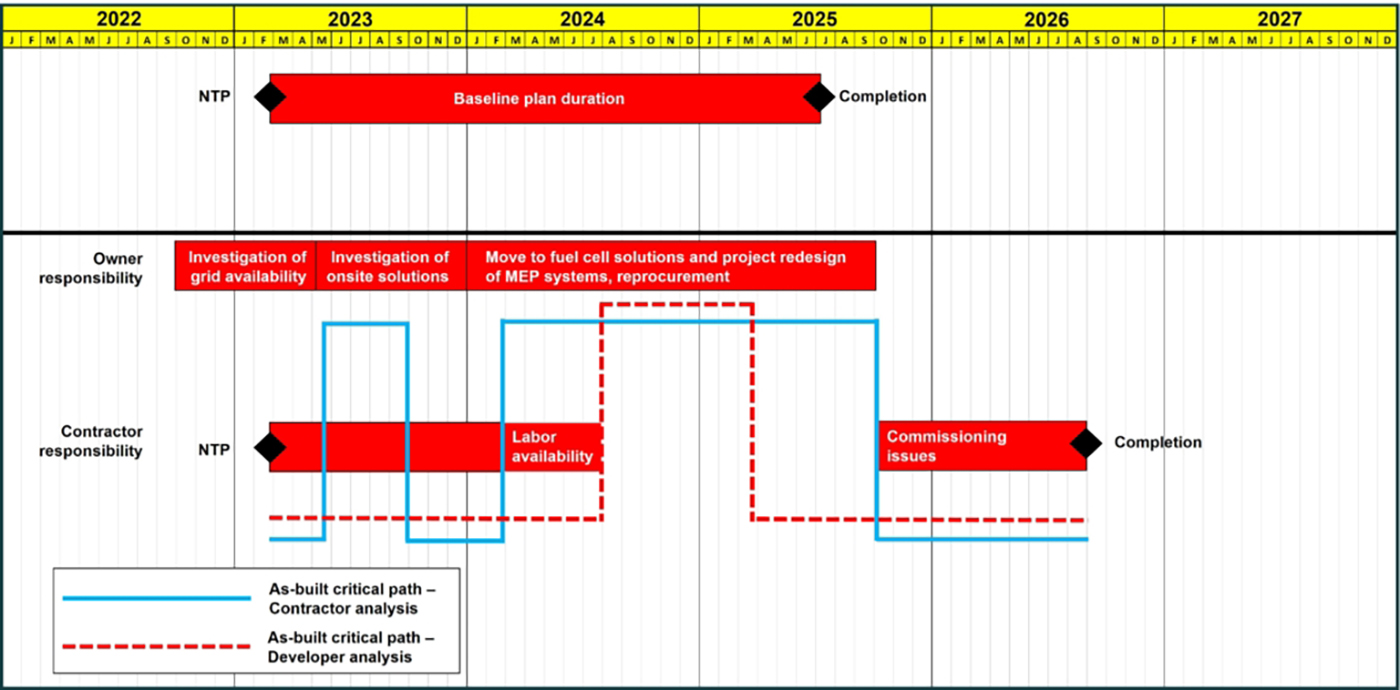
Skilled labor shortage
A 120 MW data center was being developed in Texas, where competition for skilled trades can be fierce. The general contractor selected subcontractors without much prior experience in data centers.
The electrical subcontractor forecasted a peak labor demand of 150 electricians, but a glut of projects in the Texas market resulted in the contractor consistently staffing only 60% of projected peak-demand workforce.
The subcontractor also increasingly relied on staff with little to no experience in data center environments. Combined with labor shortages, this decreased installation productivity and the quality of work performed.
Commissioning could not proceed as planned because of open electrical deficiencies and failed inspections.
The owner claimed delays were not only from manpower shortages, but also the effects of poor workmanship and the general contractor’s unfamiliarity with data centers. The general contractor blamed the electrical subcontractor, while the latter argued labor market conditions constituted an external constraint.
Design changes
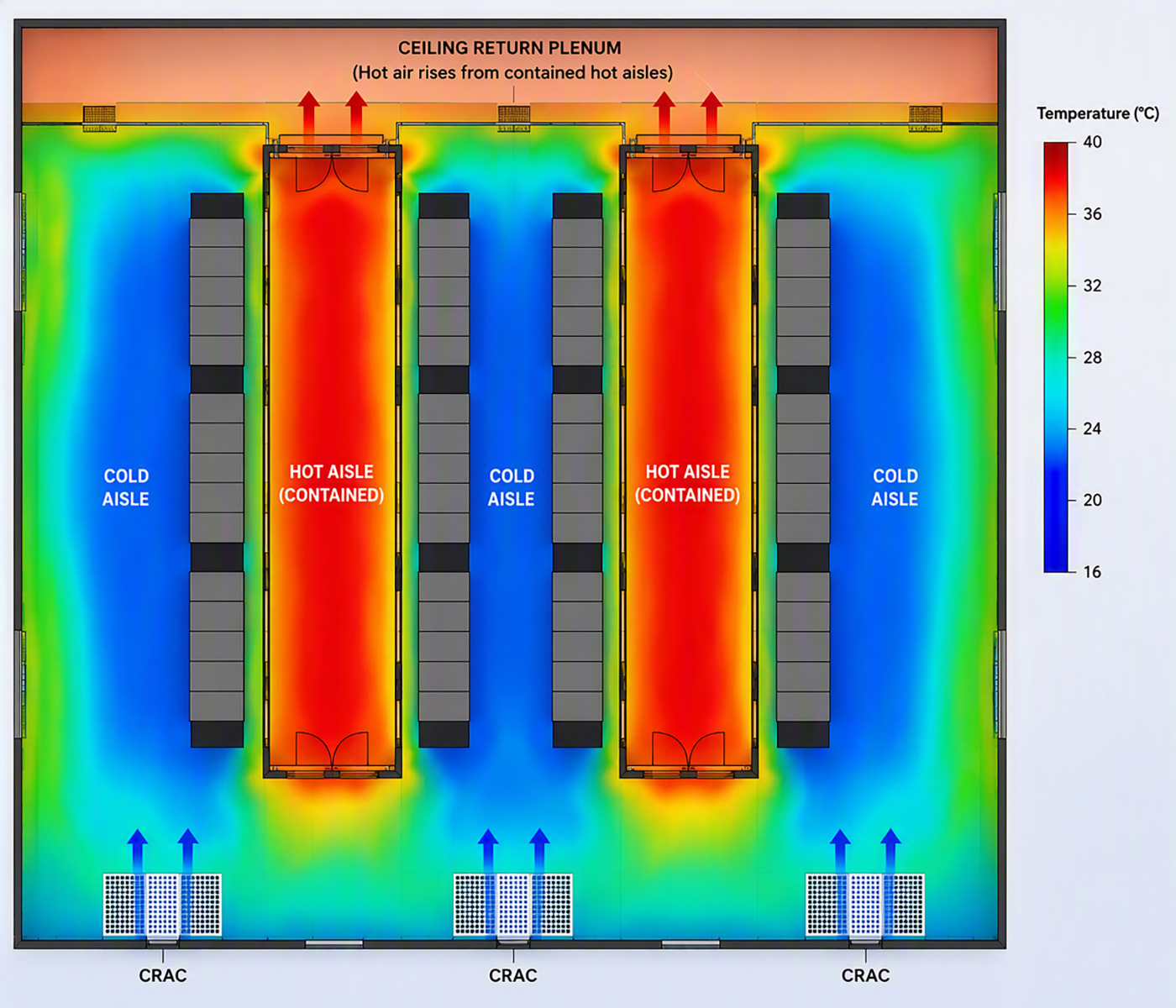
An 80 MW data center project’s mechanical design basis specified a particular computer room air-conditioning (CRAC) unit model. The design documentation stated no substitutions could be made without approval from the engineer of record.
During construction, the mechanical contractor proposed a different CRAC unit to lower costs and lead time. The general contractor and owner approved the change without consulting the engineer of record in order to maintain the overall timeline.
The alternative CRAC units differed materially in air flow delivery and fan static pressure capability, but they were integrated into the project with minimal changes to downstream distribution.
During staged load testing, the cold aisle supply temperatures were uneven, and several rack locations had localized hot spots above allowable thresholds. As such, the facility was unable to operate at the intended critical load without exceeding temperature limits, forcing a derating of IT capacity.
The project ultimately completed 6 months late, with an LD clause resulting in nearly $20 million in potential penalties against the contractor and significant delay claims against the owner.
“The insights and scenarios presented in this white paper demonstrate that data center development and construction are defined by a complex and evolving risk landscape,” the authors conclude. “To mitigate these risks, stakeholders should move beyond assumptions of linear delivery and instead adopt proactive, data‑driven approaches to risk identification, monitoring, and response.”