AI puts $4.7 trillion at stake, a far larger shift than emergence of internet: Bain study

In its various forms and in a wide array of different tools, AI is set to reshuffle nearly three-quarters of the global economy’s profit pools over the next decade. A new study from Bain & Company estimates that $4.7 trillion in corporate profits will be created, redistributed, or lost between 2025 and 2035 as companies adopt the technology.
That figure is more than triple the total impact of the internet in the years following its debut, which reshaped roughly $1.4 trillion in profits over 20 years. The comparison lands at a moment when boardrooms are still debating how much of the AI boom is just hype and how much is a genuine structural shift, and the scale of the number suggests the shift is already well underway, not a distant forecast.
With every major technology shift – whether the emergence of computers, the rise of smartphones, cloud technologies, or the internet – there is a split between those that are certain everything has changed forever, and the skeptics that do not believe in the hype. Both are right on some points and wrong on others, the authors argue.s
While the emergence of the internet mainly cut the cost of reaching customers, AI cuts the cost of producing the underlying goods and services themselves, everything from a legal contract to a factory weld. That distinction matters for how far the disruption reaches.
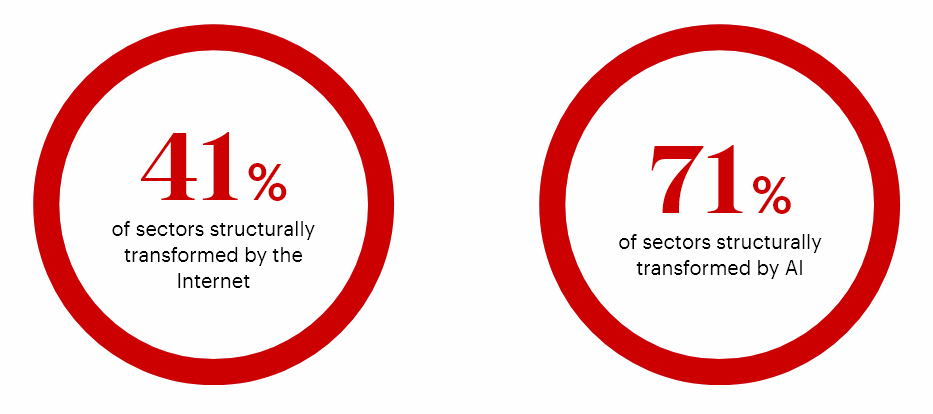
AI is expected to structurally transform 71% of sectors, compared with 41% during the internet era. That includes industries the internet mostly bypassed, like pharmaceuticals, healthcare delivery, and industrial manufacturing, sectors that sit at the core of the economy rather than its margins.
The $4.7 trillion figure breaks into three categories. Productivity gains, where AI makes existing work cheaper or faster, account for about $1.1 trillion, or roughly a quarter of the total. Consumers will capture much of the savings from productivity gains through cheaper or better products, but companies will still keep a meaningful share for themselves.
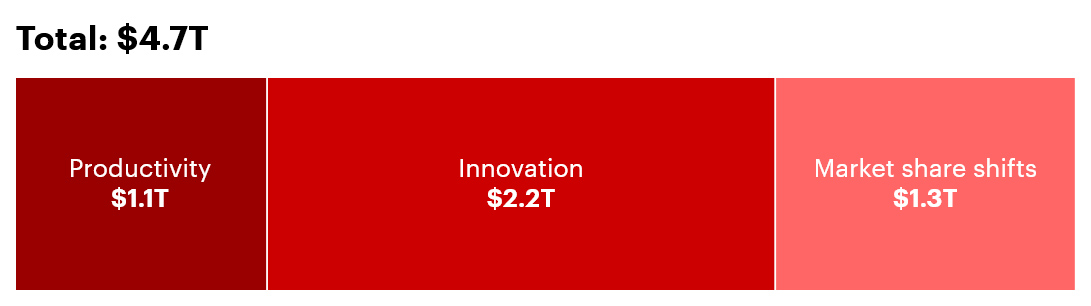
Innovation (entirely new AI-enabled products and business lines) accounts for a larger share of about $2.2 trillion. The remaining $1.3 trillion comes from market share shifting between competitors, as faster-moving companies outshine slower rivals within their own industries.
Four clusters, four different playbooks
Industries fall into four groups based on how AI is likely to hit their profit pools. The first, described as the ‘technology foundation’, covers cloud computing, semiconductors, and data centers, where demand is already surging simply because every other sector needs the infrastructure to run on.
The second, called ‘rewired’, includes healthcare, pharmaceuticals, enterprise software, and consulting, where incumbents with strong data and regulatory advantages could pull further ahead, though new entrants still have a real shot at the top.
A third group, ‘augmentation’, covers sectors such as hospitality, where AI will not change the basic business model but will reward whichever competitor moves fastest to use tools that are available to everyone.
After those, the smallest group, labeled ‘revolution’, includes customer support and test prep, where AI could replace the service itself rather than simply improving it, since the whole point of those businesses was standing between the customer and the answer.
AI both an opportunity and a challenge
There have been a lot of attempts in recent years to calculate AI’s overall economic impact, and while it is a very difficult calculation to make, various analyses have consistently landed in the ballpark of hundreds of billions up to trillions of dollars.
But realizing that enormous boost requires invest. A previous Bain report found that around $2 trillion in annual revenue is needed to fund the new computing power needed to meet anticipated AI demand by 2030. Indeed, data centers are a weak point for the growth of AI; scaling AI means more capacity – and at an ever higher price.
The overarching message for executives is to form an explicit, ten-year view of how AI will change their industry rather than reacting quarter to quarter. Early movers, the thinking goes, could build a lasting data and workflow advantage that later adopters would struggle to close, turning a modest head start today into a far larger one by the time competitors catch up.
"For CEOs, the job now is to form a view of what will matter in your industry a decade out," said Dunigan O’Keeffe, partner with Bain.
"That view is what allows you to move fast and leave your competitors at the starting gate. The $4.7 trillion profit pool shift is already underway. The question is whether your company is built to capture it – or funding someone else’s lead."