Nearly half of companies now create value with AI: BCG report

Almost half of all companies (48.5%) now generate measurable value from AI, according to a new study from Boston Consulting Group (BCG), which also projects the growing relevance of Agentic AI.
The firm’s Applied AI Index 2026 is based on a survey of 1,330 executives across more than 20 sectors. The findings suggests that the common view that most companies see little return from AI is becoming outdated.
BCG sorts companies into four groups based on how mature their AI capabilities are. The smallest group, labeled as ‘stagnating’, fell to 4.5% of companies from 14% a year ago. The share of companies classed as ‘scaling’, meaning they have strong capabilities and are starting to see results, rose to 41% from 35%. Another 47% are in an earlier ‘emerging’ stage.
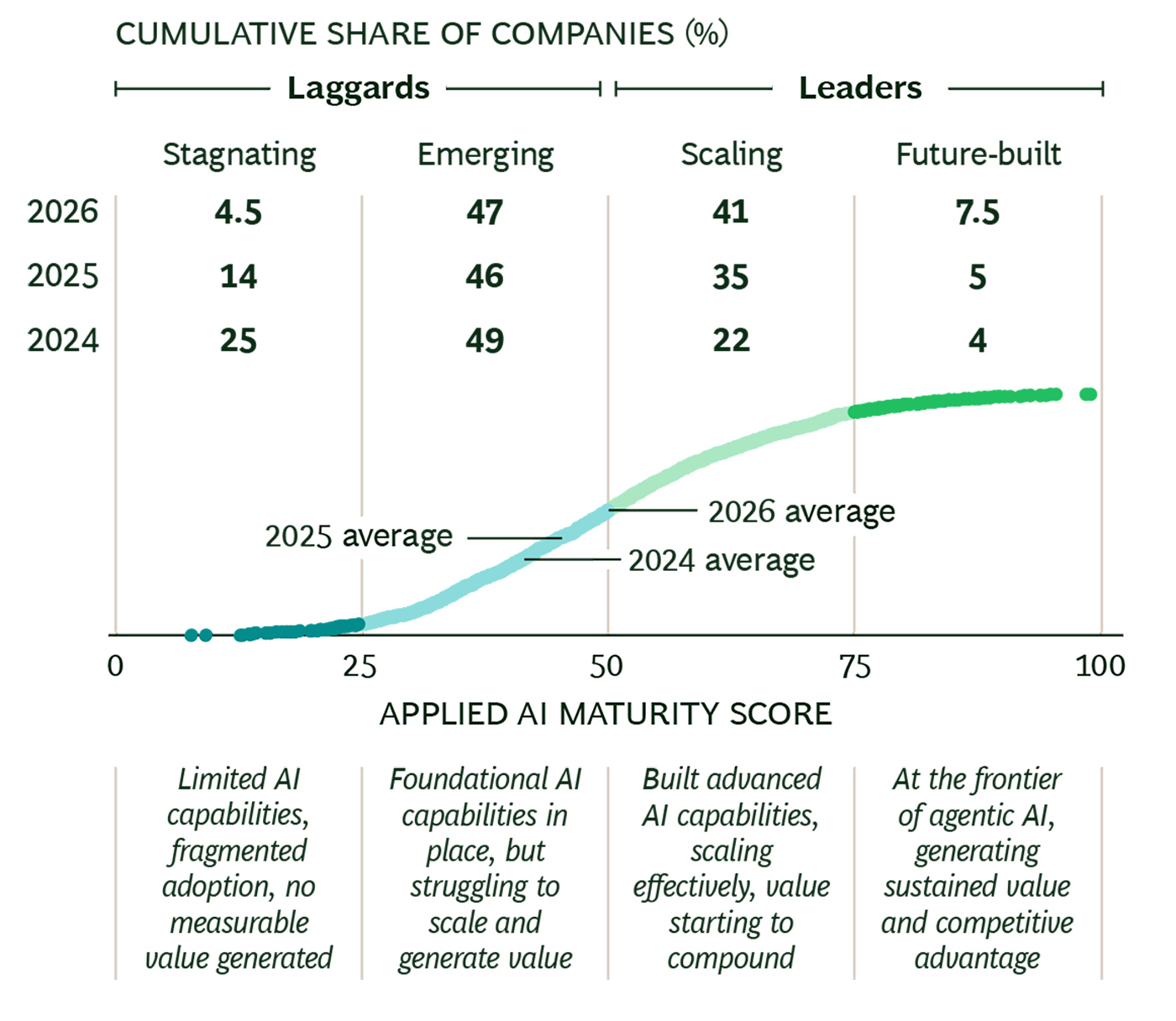
At the top are the ‘future-built’ companies, which grew from 5% to 7.5% of the total. They generate 2.4 times the revenue growth of laggards and 2.3 times the three-year shareholder return. Their earnings growth is three times as high. Scaling companies also outperform, though by a smaller margin.
BCG attributes much of the gap to two factors: clear strategy and strong everyday use of AI. Companies with both realized value equal to 4.5% of revenue, compared with 0.9% for companies with neither. Because the findings rely largely on self-reported survey data, BCG notes they may reflect perception bias.
Spending doubles, and much of it is hidden
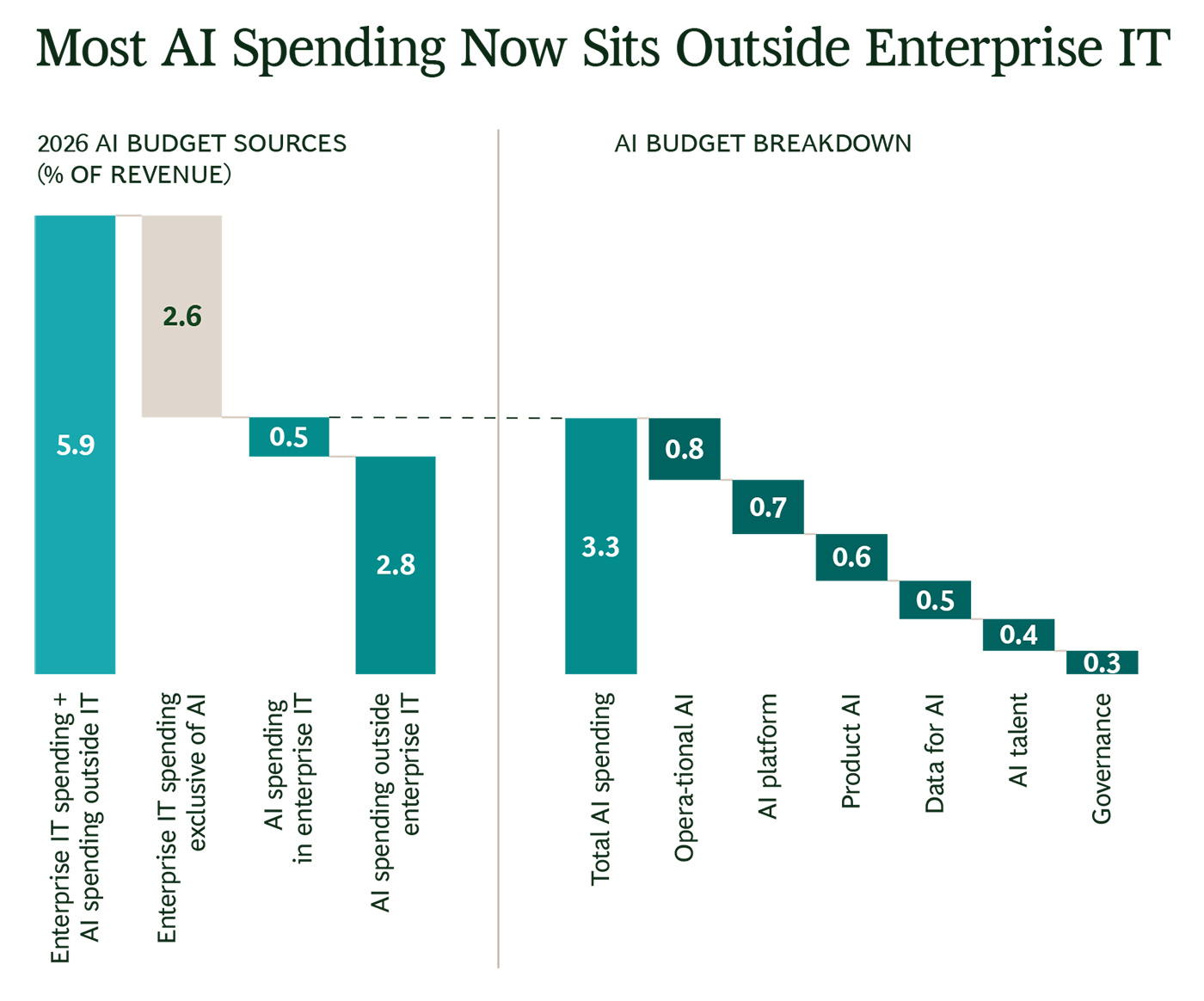
Companies now spend an average of 3.3% of revenue on AI, up from 1.7% earlier this year. More than 80% of that spending sits outside traditional technology budgets, in areas such as hiring, training, governance, and AI built into products. Technology budgets themselves have remained roughly flat.
The report says leading companies track their results closely. Some 95% of future-built companies use clear performance measures or tie AI directly to profit and loss, while 47% of laggards measure value only in general terms. Future-built companies also turn investments into results faster, reaching impact in about 11 months, compared with 17 months for laggards.
Ambition outpacing safeguards?
The analysis also flags a widening gap between how much authority companies plan to give AI agents, which are systems that can carry out tasks on their own, and how well they can supervise them. By 2030, 42% of companies expect agents to act without human approval, yet only 5% have the necessary controls today.
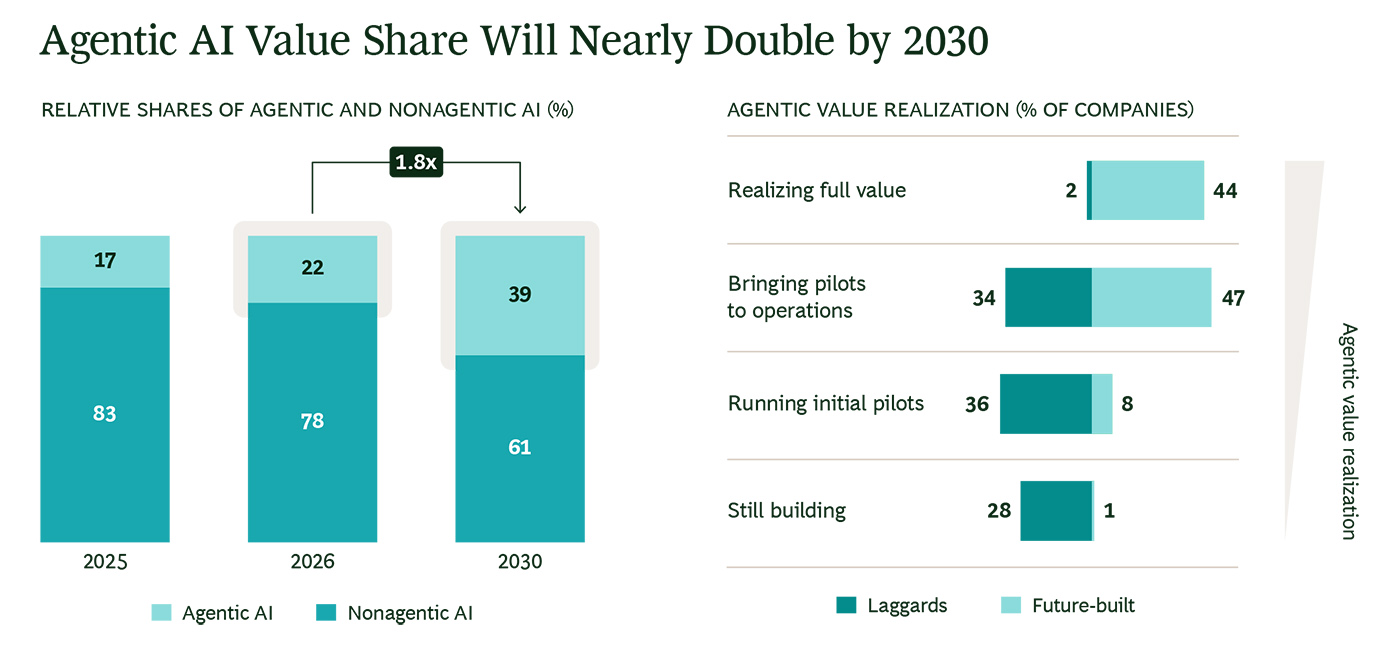
BCG identifies six controls: Managing how agents store and use memory, defining their scope and human oversight, testing them and being able to reverse their actions, standardizing the tools they connect to, assigning clear owners, and setting security and cost limits. Companies with all six in place enterprise-wide generated about three times as much value from agents as those with only one. Agents currently account for 22% of AI value, up from 17% last year, and BCG projects that figure will reach 39% by 2030.
Roles will change, especially in the middle
Companies expect AI to reduce their workforces by roughly 10% to 15% by 2030, with the cuts falling mainly on middle management and frontline supervisors. Even so, 89% of respondents expect AI to create new work, while only 11% expect it mainly to replace existing jobs. Dedicated AI roles are expected to grow from 7% of the workforce in 2026 to 22% by 2030.
Future-built companies are also more likely to plan ahead. Some 55% practice strategic workforce planning, compared with 17% of laggards. As companies adopt new AI tools, it is becoming more important than ever to upskill employees and hire new talent with specific AI skills, especially when building or maintaining new tools in-house.
People matter more than technology
BCG says the findings point to a simple lesson: becoming a leader in AI is mostly about people and processes, not technology. Under its 70-20-10 model, successful companies devote 70% of their effort to people, organization, and processes, 20% to technology and data, and 10% to algorithms. The firm also stresses that leadership is not limited to any one industry, since every sector in the study included at least one future-built company.
The report concludes that companies that focus on their AI goals, empower their people, and ultimately scale the most important workflows will be able to move beyond AI experimentation to enjoying real advantage.
"Companies at lower AI maturity levels often think that the goal is to simply deploy more tools, fund more pilots, or chase the newest technical breakthrough. As our data shows, that approach won’t work,” said Vinciane Beauchene, managing director and partner at BCG.
"Becoming an agentic, future-built organization requires a disciplined agenda anchored in strategic clarity and applied AI. The organization must embed programs into the way work gets done, govern them with confidence, and measure them by the value they create. Agentic AI raises the stakes because it transforms AI from an assistant at the edge of the enterprise into a participant in its core operating model."