AI boosting revenue for software firms – but measuring ROI and costs remain difficult

Software companies say AI is boosting their revenue, but many have yet to work out how to price it, prove its worth, or track what it costs to run, according to a recent report from pricing consultancy Simon-Kucher.
The firm’s Global Software Study 2026 draws on August surveys of 492 software executives and 200 software buyers. Seventy-nine percent of executives say AI is already lifting revenue – although 62% see at least a moderate risk that AI will displace their core products within two years.
Buyers plan to spend
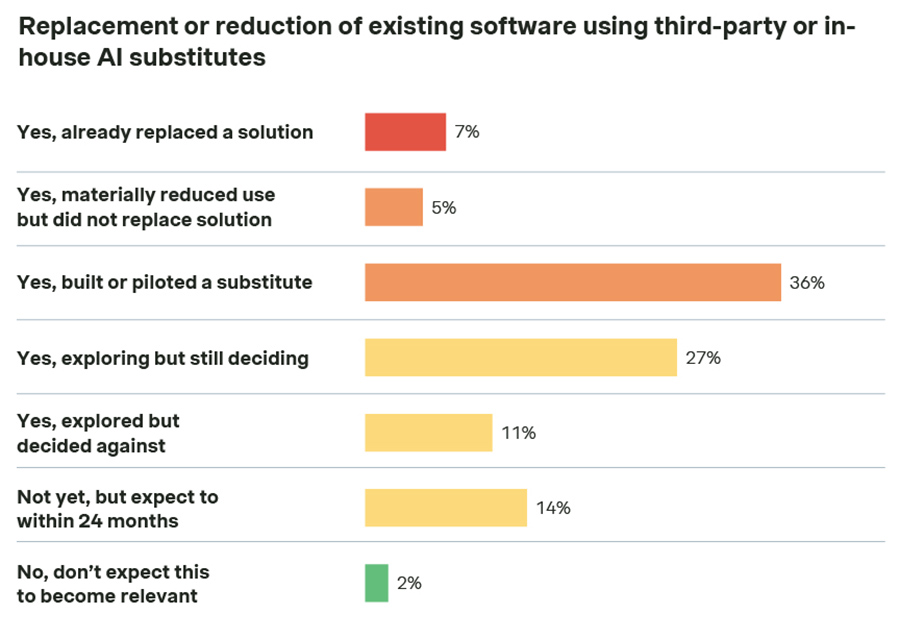
Eighty-six percent of respondents expect AI-related software budgets to grow by at least 10% over two years, compared with 43% for traditional software. Actual replacement is still rare, with 7% of buyers having swapped a conventional product for an AI substitute – though 36% have built or piloted one. Customer service, productivity, and analytics tools face the most risk of replacement.
Measuring results is a weak point
While 98% of buyers say AI has met or beaten their expectations, only 4% measure its business impact across the whole company. Two-thirds want quantified financial returns before signing deals, and 55% expect payback within a year.
Pricing is still in flux
Just 40% of vendors describe their AI monetization models as mature, and 94% have changed or plan to change their models. Pay-as-you-go pricing is expected to grow from 42% of vendors to 61% within two years. Buyers also desire predictability, with 51% asking for spending alerts and 48% wanting hard spending limits.
Costs add pressure
Executives expect a median 20% in ongoing AI cost-to-serve over the next two years, yet 86% still expect improved gross margins in the same time period. Only 23% currently track AI cost-to-serve at the account or workflow level, which can obscure gaps in profitability between customers paying the same subscription fee.
AI agents raise another question
Ninety-three percent of buyers use, pilot, or plan to use agents to access third-party software, but only 23% of vendors charge for machine access separately from a human seat. Beyond impacting revenue, agents can change who controls the customer interface and generate activity costs that seat-based contracts were not design to capture.
Software providers are setting boundaries, with nearly three-quarters saying governed agent access is the default policy.
Buyers lean toward bundling, with 43% preferring agent access folded into product tiers and just 6% favoring per-agent fees.
Simon-Kucher identifies four strategic areas for software leaders to focus on in order to close the AI commercialization gap: defend their core products, prove customer value, keep refining AI monetization, and set rules for agent access.