Building a high-performing B2B sales engine

Leaders who invest earlier into sales talent and scale AI across processes are driving higher margin outcomes, according to a recent Simon-Kucher report.
The sales and marketing consultancy in its 2026 Global B2B (business-to-business) Sales Study examined how manufacturers, wholesalers, and service provider are evolving their operating models.
The report found that AI usage in B2B sales has tripled since 2025. Companies are experimenting across multiple vendors, with more than 80% of respondents using at least one AI solution for each sales process step.
Adoption is no longer a differentiator, so the next challenge is demonstrating measurable impact. Many companies still need to prove AI usage is increasing sales and/or productivity.
The trends shaping commercial success
The top performers in B2B sales are termed “Allstars,” combining high reported revenue growth with high reported gross margin. They are best able to translate sales investment into commercial returns and invest more in hiring, incentives, and AI.
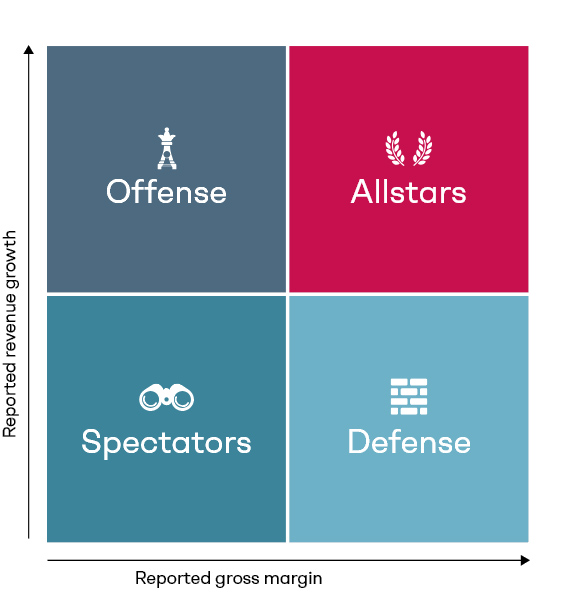
Allstars invest in sales capabilities before the organization reaches maturity. Simon-Kucher says that commercial capabilities can’t be treated as a late-stage lever – with investment needed as a company matures before pressure exposes gaps.
Allstars are also the most active experimenters in AI, with 90% using it across steps such as targeting prospects and automating operations.
Offense firms have high revenue growth but narrower gross margins. They need to focus on improving quality of commercial execution via sharper targeting, better qualification, and stronger value messaging.
Defense firms have strong gross margins but weak revenue growth. They need to make targeted investment in growth capabilities and levers such as account expansion, cross-selling, customer acquisition, and channel optimization.
Spectators have weak revenue growth and profitability. Their shortfalls can include salesforce underinvestment, weak execution readiness, risk-averse tech investment, and customer interactions focused on operations. Spectators should identify high-leverage commercial gaps for customer acquisition, sales steering, value messaging, and AI workflow integration.